

JIM JACOBS
ONLINE EXCLUSIVE EXHIBITION

Jim Jacobs is a sculptural artist based in Ogden, Utah. Jacobs received his Bachelor of Fine Arts from Jacksonville University in Florida and his Master of Fine Arts from East Carolina University in North Carolina. In 1985 Jacobs moved to Utah where he taught visual arts at Weber State University up until 2015. Inspired by the relationship between humans and the environment, he began incorporating woven tree branches into his paintings, which eventually evolved into an exclusively sculptural practice. Jacobs believes wood is deeply entwined in our lives – it has a physicality and a relationship to our bodies which lends itself to be metaphors for us, our social and political idiosyncrasies and, in particular, our role in nature.
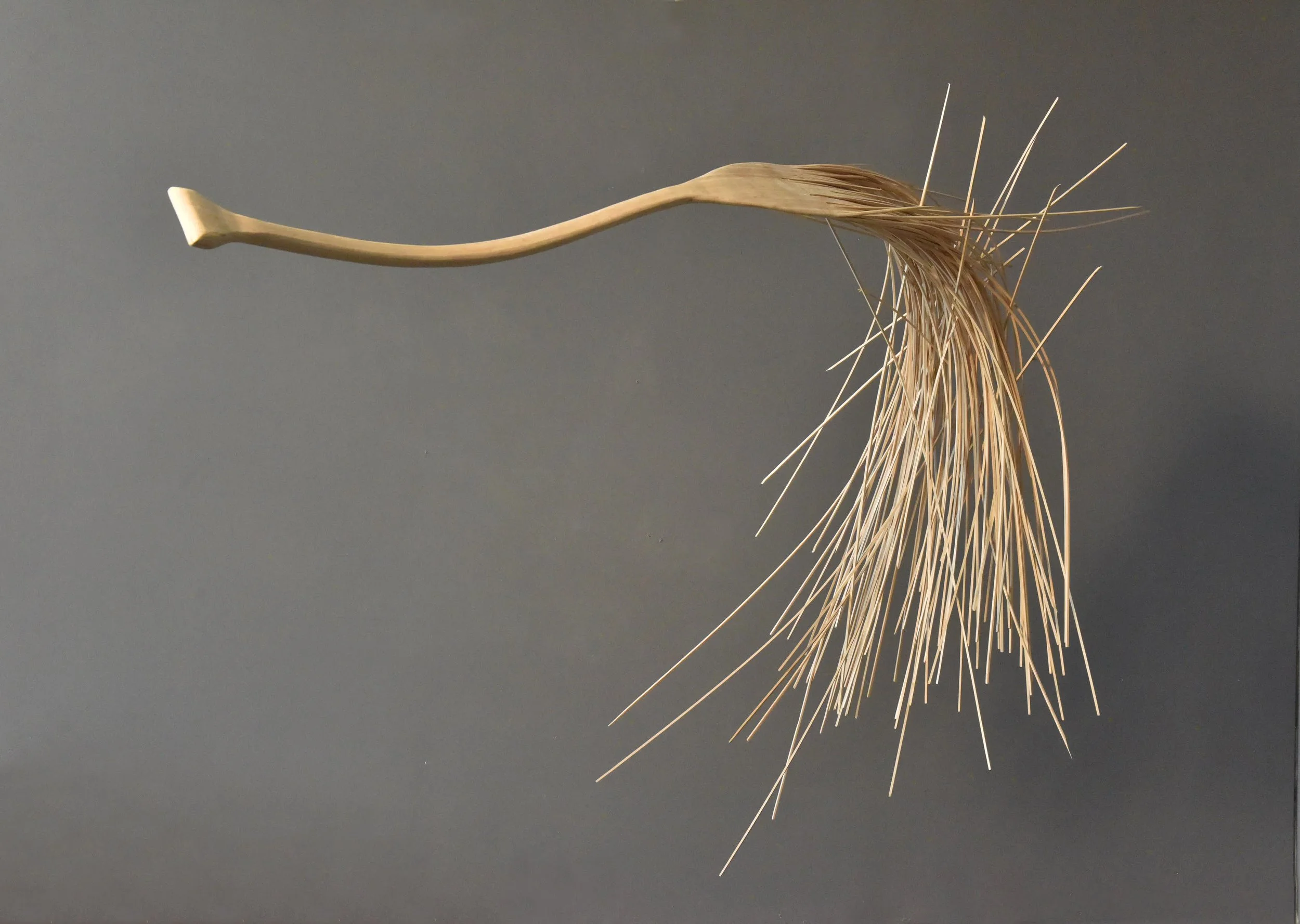
Jim Jacobs | A La Deriva, 2026 | maple wood | 67 x 75 x 85 in. | $7,000

Jim Jacobs, 'Dead Reckoning,' 2019, mulberry and maple wood, 48 x 40 x 34 in., $5,400
Jim Jacobs, 'Ouroboros,' 2016, apple and maple wood, clothespin spring, 34 x 21 x 2 in., $2,600

Jim Jacobs, '61520,' 2020, cherry wood, 36 x 36 x 12 in., $3,800

Jim Jacobs, 'Body Check,' 2023, maple and apple, 56 x 36 x 8 in., $4,500
Jim Jacobs, 'Absalom,' 2017, cherry wood and human hair, 50 x 46 x 21 in., $5,200

Jim Jacobs, 'Patas Arriba,' 2019, found chair, maple and apple wood, 110 x 52 x 72 in., $9,400

Jim Jacobs, 'Flagellate,' 2016, maple and apple wood, 46 x78 x 25 in., $5,500

Jim Jacobs, 'Breach,' 2021, maple, wood, 50 x 120 x 120 in., $11,600

Jim Jacobs, 'Tap,' 2016, cherry wood and sledge hammer head, 52 x 2 x 20 in., $3,500

Jim Jacobs, 'Slip,' 2015, maple and mulberry wood, 46 x 110 x 14 in., $7,200

Jim Jacobs, 'Exchange,' 2022, maple wood, 39 x 145 x 30 in., $11,600

Jim Jacobs, 'Unskinned #5,' 2023, maple and apple, 41 x 20 x 10 in., $4,000
You started your career as a painter. What event/emotion/inspiration directly influenced your pivot to sculpture?
The transition was gradual both formally and conceptually. As a painter in the 1980s, my stretchers were dimensionally complex. At the time I was exploring the relationship between the painting and its environment, the wall. Over time, more and more canvas was removed and more of the stretcher and wall were exposed. Later, the notion of environment, expanded beyond the wall and the paintings began to incorporate tree branches into the wooden stretchers, From there, it was a short jump to graft.
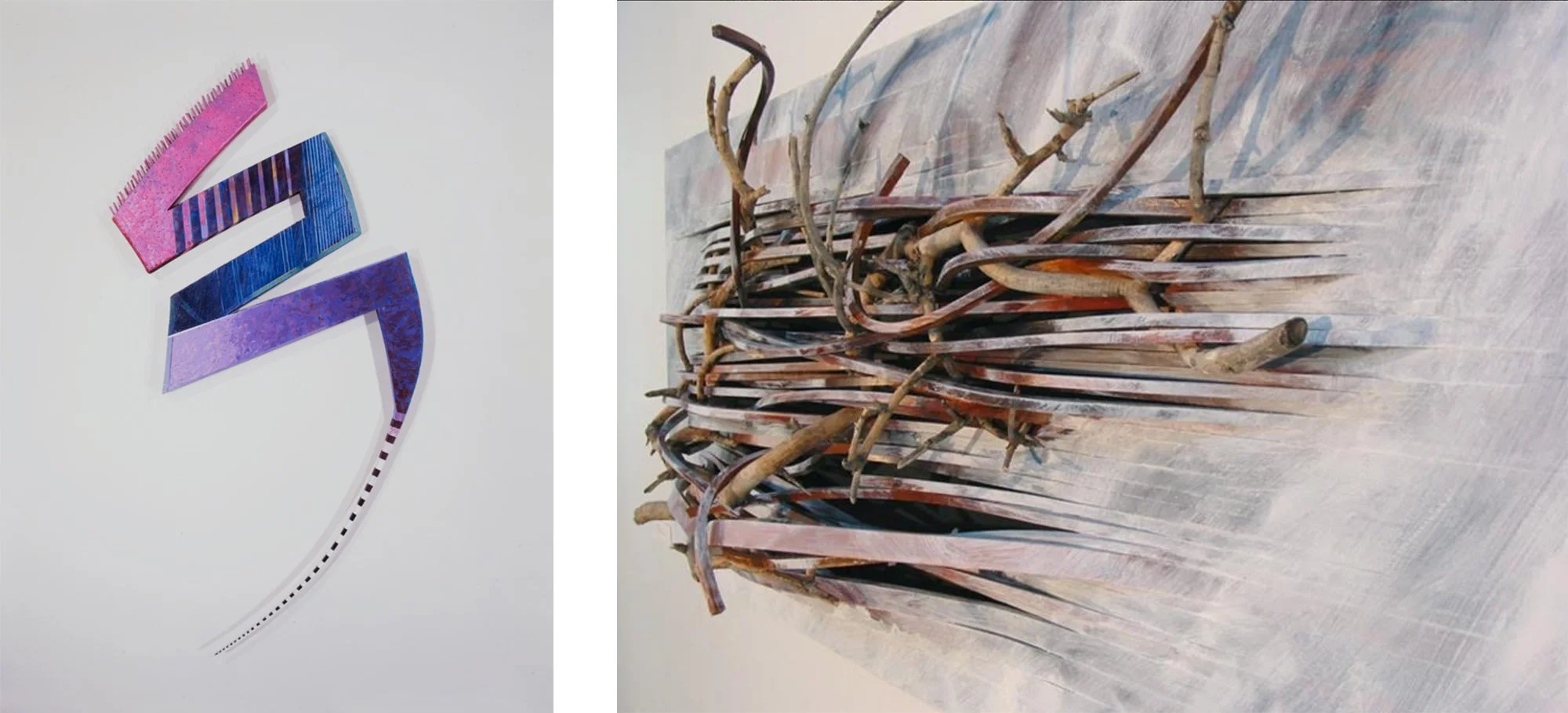
Early examples of Jim Jacobs’ work.
You've mentioned in working with wood you've been inspired by the connection between humanity and nature. Did any of this inspiration derive from your move from the eastern to the western landscape?
In the East I lived in Pennsylvania, North Carolina, and Florida. Two striking changes I noticed in my move from the East to the West were the size of the mountains and the number of trees. Driving in the summer in the outskirts of Philadelphia was like driving through the jungle. We tunneled through forests of oaks, beech, ash and other trees. In Utah one is rarely lost in the greenery. We can almost always get a visual fix, often a mountain, to determine our location. With some knowledge of the surrounding landmarks, you know where you are.
In my late-teens and early-twenties I built houses. The sticklike structure of unsheathed walls was captivating. The canvas in my paintings in graduate school were stretched over complex wooden structures. Although I eventually abandoned the canvas, I didn’t integrate branches into these forms until I moved to the West.

How do the origin of your materials influence the meaning or the narrative of each piece?
Most of the branches I use are sourced from my yard. It was easy for me to reflect on the relationship of humans to nature as I watched these trees grow for decades.
I’ve also used human hair fused to branches in my work, such as in Absalom, (who was a character from the Bible who, while in battle, finds his long hair caught in the branches of an oak tree. As such, he is caught and easily killed.) to further explore the idea that we are inseparable from other living organisms. Once making these works, I was intrigued by the source of the hair. Most of it comes from India. Women donate their hair in a temple as an act of devotion. The hair is then collected and sold globally for substantial profits. While some organizations do direct money back to communities in need, most of the profits are absorbed by others. I believe this information adds an additional layer of complexity to these works that resonates with the original ideas.

Jim Jacobs
Absalom, 2017
cherry wood and human hair
50 x 46 x 21 in.
$5,200
What is your process of selecting the physical materials to incorporate with the wood?
The selection of processed materials varies depending on the work. In both Exchange and Crest I used chair forms because of their relationship to human bodies. Besides the functional relationship to human bodies, wooden chairs frequently have the impression of a human backside carved into them. In Exchange I used a student desk because I was thinking about learning environments and the variety of exchanges that take place in those environments. In Crest I used a chair that was both tipped over on its back and fused, or grafted, to natural tree branches that arc over the chair. I hoped to evoke ideas of wonderment and balance. While chairs can act as metaphors for the body, hair, as in the Ponytail series, is part of the body.
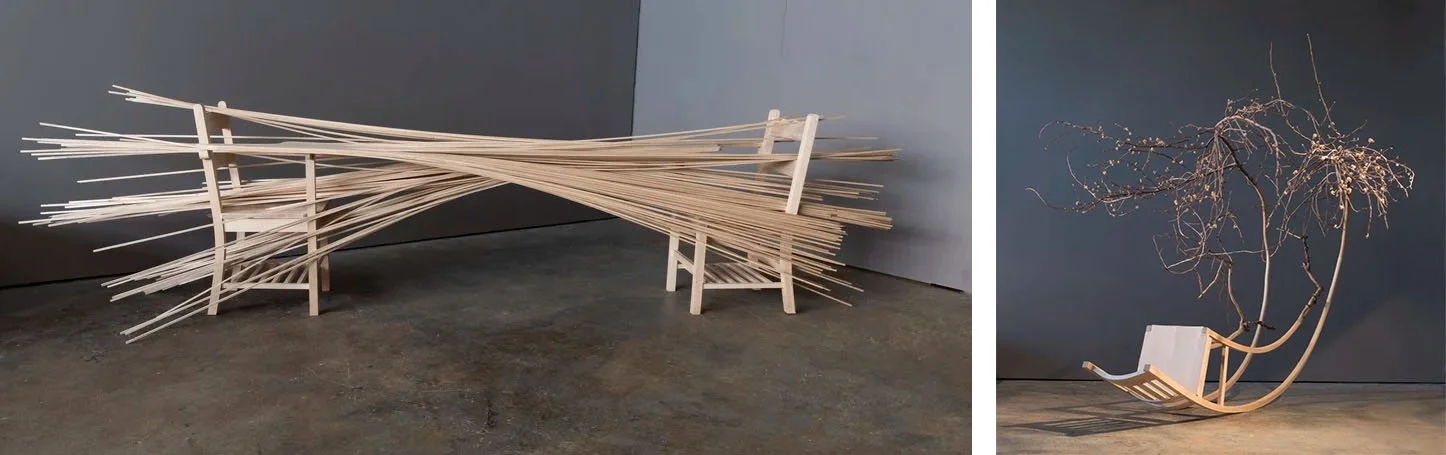
Exchange (left) and Crest (right)
You are also interested in social and political idiosyncrasies. Have the local political and environmental crises augmented your interest in these topics within your work?
My concern about political and environmental issues has grown since moving to the West. Some of these problems have a national or global scope. Other concerns are specific to challenges faced by our region, such as our limited water, the shrinking Great Salt Lake, and the toxic dust exposed in the lake bed. These issues do contribute to the direction of my work but not always in an overt manner.

A look inside the artist’s studio in Ogden, Utah.

Jim Jacobs
Mika's Ponytail 11, 2022
willow, human hair
39 x 5 x 3 in.
$1,500

Jim Jacobs
Ouroboros, 2016
apple and maple wood, clothespin spring
34 x 21 x 2 in.
$2,600
For more information on artwork details and acquisition, please contact us at info@modernwestfineart.com.